
Steering, batteries & fuel
Outboard hydraulic steering and helm rigging: quotation checklist
Updated
Missing rigging can turn a boat-and-engine quote into another installation bill. Match outboard hydraulic steering to the exact engine and hull, then list dual-battery and fuel-system scope separately. Use this helm rigging checklist to record what is supplied, installed and checked before comparing offers.
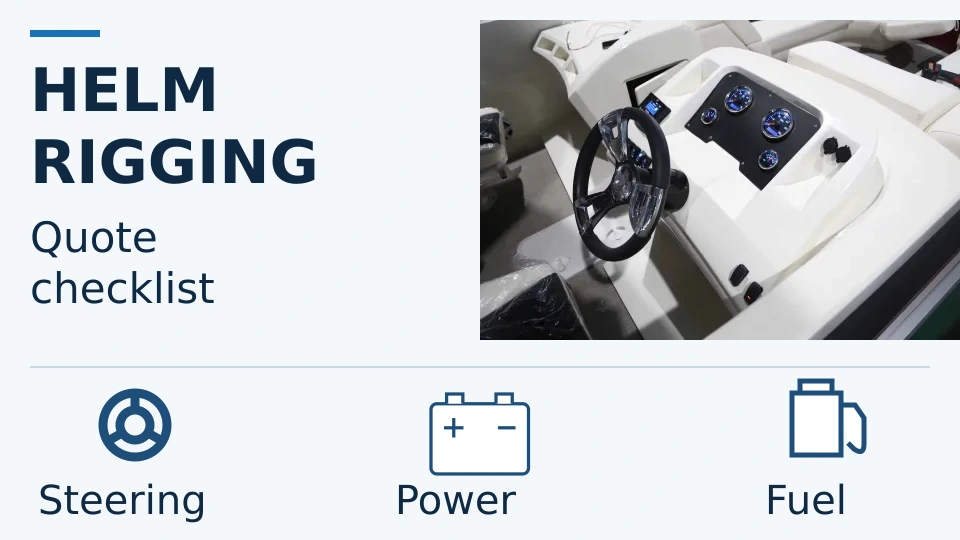
Start with the engine and installed package
A comparable quote identifies the complete steering system, the jobs assigned to each battery bank and the fuel system delivered with the boat. Horsepower, battery count and boat fuel tank capacity are starting inputs; each needs an equipment identity and a defined scope. Record preferences in the SEAVIA configurator, then request a written configuration for your destination. This checklist supports that buying decision; installation and operating settings come from the selected equipment manuals and installer. Before choosing the engine variant, use the outboard shaft length and transom measurement checklist to record the hull or motor pod references separately from a trolling motor’s waterline measurement.
| Input or item | Value or source to record | Why it matters |
|---|---|---|
| Engine and boat | Exact engine model/year, rated power, boat and final layout | Defines the combination the installer must assess |
| Steering | System, helm and cylinder/cable part numbers; applicable manual | A kit name alone leaves interfaces unresolved |
| Electrical use | Start/house jobs, battery chemistry, accessory loads and hours | Frames isolation and charging questions |
| Fuel | Tank identity, capacity units and documented usable-fuel conditions | Separates a catalog volume from a planning input |
| Responsibility | Destination, supplier, installer and handover provider | Makes local work and exclusions visible |
Does horsepower decide cable versus hydraulic steering?
There is no universal cable-to-hydraulic changeover point for the 115–200 hp range. Ask the supplier to identify the steering system permitted for your engine and boat, including steering load, speed envelope and mounting arrangement. A hydraulic label does not establish compatibility with a pontoon or a particular outboard.
A useful manual-specific boundary is Dometic’s BayStar Book 22.3, Revision E (2022): it limits that system to 150 hp total and cautions against high-steering-load applications, expressly including pontoons. Its guidance directs those applications toward a different system. That is a limit of the named equipment, not a SEAVIA horsepower rating or a universal steering rule.
| Quote route | Evidence to request | Scope to compare | Dominant Failure Mode & Prevention |
|---|---|---|---|
| Mechanical cable | Written engine/boat application approval and cable-route requirements | Named helm, cable, engine connection, mounting and installation | Binding or restricted travel: require installer verification against the selected system manual |
| Manual hydraulic | Matched helm, lines, cylinder and engine application | All fittings, fluid, mounting, fill/purge and commissioning | Leaks, trapped air or line interference: include manual-based installation checks and records |
| Assisted or integrated steering | Exact engine/control architecture and approved system documentation | Actuator or assist equipment, power/control interfaces and setup | Unresolved interfaces: obtain an approved complete parts list before accepting substitutions |
Selection rule: if the engine exceeds a proposed system’s documented power limit, exclude that system. If it falls within the limit but the manual excludes the boat’s application or steering load, request another approved system. A 150 hp ceiling cannot make a high-load pontoon application acceptable by itself.
What must the steering installation line include?
Ask for a continuous equipment list from the wheel to the engine connection, with one named party responsible for installation and checks. The hydraulic helm converts wheel input into fluid pressure and flow; the lines connect it to the cylinder that moves the steering mechanism. Use the diagram to find quotation gaps, then have the installer resolve fit against the actual engine and boat.
- Identify wheel and helm, cylinder and engine attachment hardware, lines/tubing, fittings, specified fluid and mounting parts. Mark supplied, buyer-supplied, excluded or pending against each item.
- Request the installer’s confirmation of behind-dash space, transom/splashwell clearance and line movement through the required steering and trim/tilt travel.
- Include filling/purging, the equipment manual’s system checks, an installed-parts record and owner instructions in the acceptance scope. State who performs and records each task.
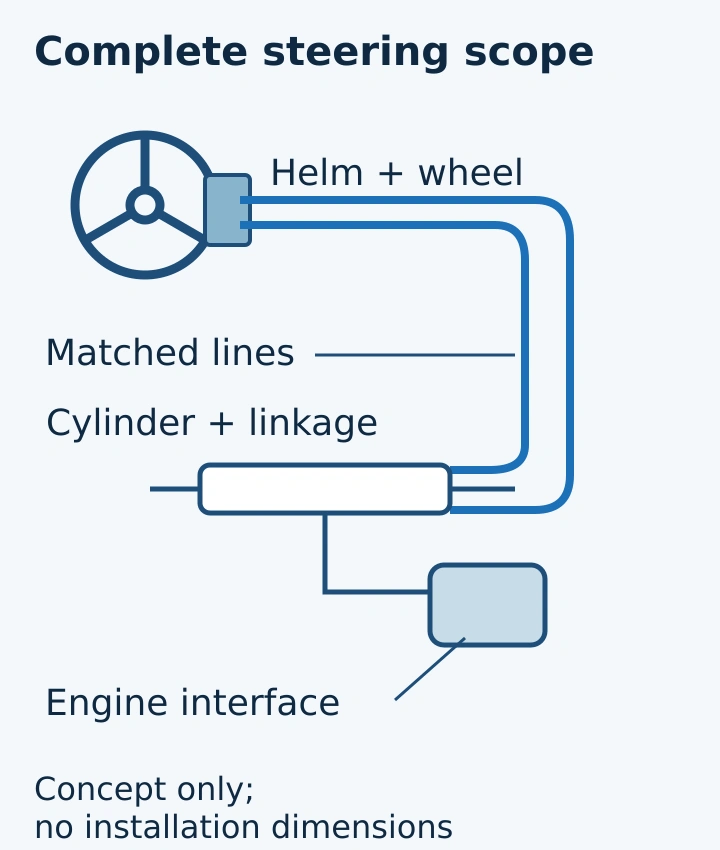
ISO 10592:2022 addresses design, installation and testing of remote hydraulic steering, including outboard applications over 15 kW per engine. Ask which applicable standard and supporting documents the supplier uses for the proposed assembly. The standard’s scope does not certify a boat or establish that a quoted kit fits it.
What does a dual battery setup for a boat actually include?
A dual battery setup should state which bank starts the engine, which supplies house loads and how both receive compatible charging. An automatic charging relay (ACR), often described as a voltage-sensing relay (VSR), can join banks during charging and separate them after voltage falls. It does not independently assign charge to whichever battery needs it most. The actual relay’s voltage and timing rules belong in its manual.
Start isolation is a separate feature to confirm on the named device and installation. Blue Sea Systems’ SI-ACR 7610 documentation describes temporary separation during cranking to protect house electronics from voltage dips and spikes. Two batteries or an unspecified relay do not establish that this feature is fitted and enabled.
Record an accessory energy budget before discussing house-bank capacity: energy demand (Wh) = sum of average load (W) × operating time (h). Hypothetical inputs: 30 W of electronics for 4 h plus 10 W of lighting for 2 h gives (30 × 4) + (10 × 2) = 140 Wh. This is a load worksheet, not a battery size: usable battery energy, charging losses, starting requirements and reserve still need equipment-specific review.
| Electrical item | Written answer to request |
|---|---|
| Batteries | Make/model, chemistry, assigned bank, capacity basis and engine starting requirements |
| Switching and isolation | Switch and relay identities, operating modes and whether start isolation is connected |
| Charging | Engine output and charger compatibility with both batteries; any required additional charging equipment |
| Installation | Installer-designed protection, cable sizing/routing, terminal protection, mounting and access |
| Acceptance | Recorded checks of intended load separation and charging, plus owner switching instructions |
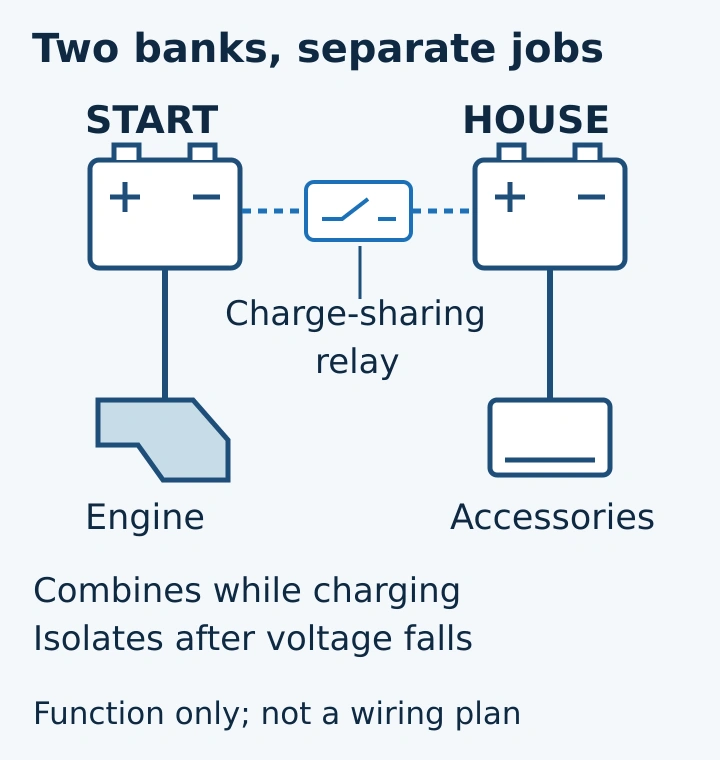
If a proposed charging arrangement lacks written compatibility with either battery’s chemistry and charging requirements, keep that line pending. Ask the installer to specify the complete charging solution before accepting a mixed-battery substitution.
Which fuel capacity belongs in the quotation?
Request the tank’s stated capacity and the boat installation’s usable-fuel figure as separate fields, with liters or US gallons explicitly identified. Ask what normal fill condition and boat attitude the usable figure assumes. A pickup’s position and tank orientation matter: Moeller’s open-stock tank guidance provides tank-specific usable-gallon information by static angle and orientation. A generic deduction from label capacity cannot replace that information.
List tank, sender/gauge, pickup, fill and vent equipment, fuel lines, filtration and engine connection separately, with each marked included, excluded, buyer-supplied or pending. A tank package can leave other fuel-system components outside the box. Have the supplier name the complete system, destination requirements, installer and inspection scope rather than assuming that “tank included” means “ready to run.”
For a comparison worksheet, fuel allowance after reserve (L) = documented usable fuel (L) − separately chosen reserve (L). Hypothetical inputs of 72 L usable fuel and a 20 L reserve give 72 − 20 = 52 L. The 20 L is an arithmetic assumption, not a recommended reserve. If the supplied figure already deducts a reserve, do not deduct it again. This calculation establishes neither range nor permission to make a trip.
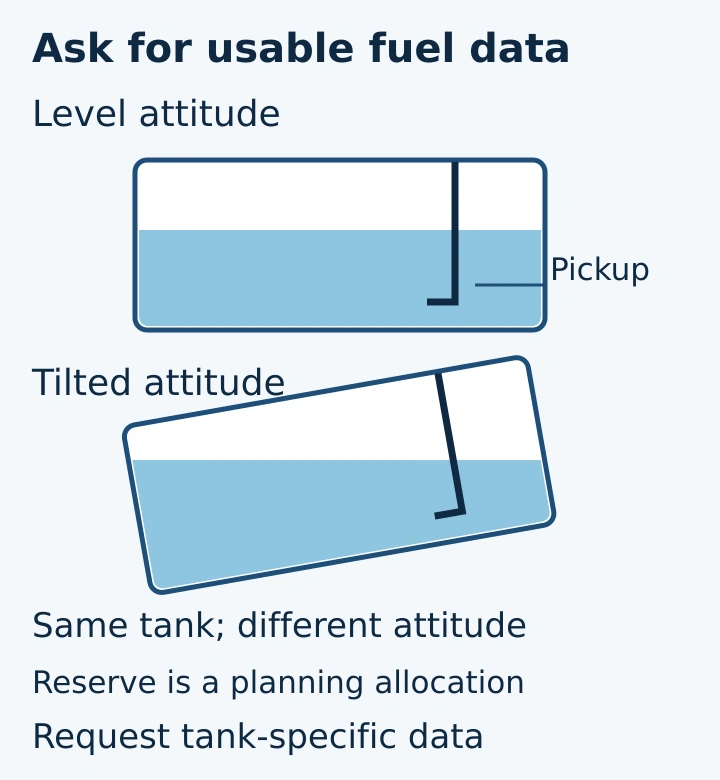
Ask the handover provider to explain the gauge’s indication and the installed system’s fueling instructions. Obtain consumption evidence for the actual boat, engine, load and use before calculating a route budget.
Compare installed scope and the same ownership period
Compare complete installed packages before comparing a steering-kit price. Use the pontoon boat cost guide to keep rigging, delivery and recurring ownership amounts in one budget without counting an included item twice. Keep unresolved amounts marked pending instead of entering zero.
| Cost line | Hidden work to include | Evidence or owner |
|---|---|---|
| Initial installation | Parts outside the kit, mounting, routing, fluid, commissioning and local labor | Installer’s itemized scope |
| Service over your chosen period | Manual-based inspections, consumables, access labor and transport | Service provider and fitted manuals |
| Changes after delivery | Removal, replacement parts, repeat commissioning and another service visit | Written responsibility for resolving an incompatible or incomplete package |
| Battery replacement | Actual replacement basis, installation and disposal | Battery documentation and local quote; no assumed life guarantee |
Same-period rigging cost = installed acquisition cost + scheduled care + replacements + additional visits during that period. Price both alternatives over the same years and use the same labor basis. For a hypothetical workload only, two visits at 1.5 hours each plus 2 hours of rework total (2 × 1.5) + 2 = 5 labor hours; multiply by your provider’s quoted rate. This does not predict the service schedule or savings of either system.
What to send us
Send your model or intended use, destination and completed scope notes on WhatsApp to discuss a configuration-specific quotation. Use the buying guides if you are still choosing the boat. Mark uncertain equipment pending and identify buyer-supplied parts so the conversation starts with the actual package you want.
| Item | Why we need it | Example format |
|---|---|---|
| Boat, engine and use | Frames the steering application | Model link; exact engine/year if selected; home waters and intended use |
| Steering scope | Identifies component and installation gaps | Helm/system proposed; engine/transom photos; parts supplied or pending |
| Battery and loads | Frames isolation and charging questions | Start + house requested; battery details if known; W and hours for accessories |
| Fuel definitions | Makes tank figures comparable | Tank ID; capacity/unit; usable-fuel basis supplied or pending |
| Destination and responsibility | Separates regional supply from local work | Country/region; intended installer; included/excluded/pending list |
Opening WhatsApp prepares a conversation. Send the message there to share your request; regional supply, equipment compatibility and the final written scope still need confirmation.
Method and sources
Updated October 2026; sources checked October 19, 2026. This checklist combines OEM-specific steering and charging guidance with the public scope and preview of ISO 10592:2022. The 2016 tank document illustrates why package contents and usable-volume conditions need tank-specific answers; obtain current documents for the tank actually offered. No catalog component rating is a SEAVIA boat specification.
The diagrams explain component boundaries and functions; they are not installation drawings. The energy, fuel and labor examples use assumed inputs to show arithmetic. The supplier’s approved configuration, fitted-equipment manuals and named installer govern the final assembly and checks.
- Dometic BayStar Book 22.3, Revision E (2022): application limits and system scope
- ISO 10592:2022: remote hydraulic steering scope (public abstract)
- Blue Sea Systems: Automatic Charging Relay Explained (March 20, 2009)
- Blue Sea Systems SI-ACR 7610: start-isolation feature and documentation
- Moeller open-stock fuel tank list (July 29, 2016): cover-page scope and usable-fuel conditions