
Trailer selection
Bunk vs. roller vs. scissor boat trailers: selection and ramp checklist
Updated
A trailer that launches easily can still support the wrong part of your boat. Compare bunk, roller and scissor boat trailers by approved support first: pontoon bunks carry the tubes, conventional scissor trailers lift beneath the deck, and fishing-boat bunks or rollers must match the hull. Then check the ramp and the complete loaded towing package before accepting a quotation.
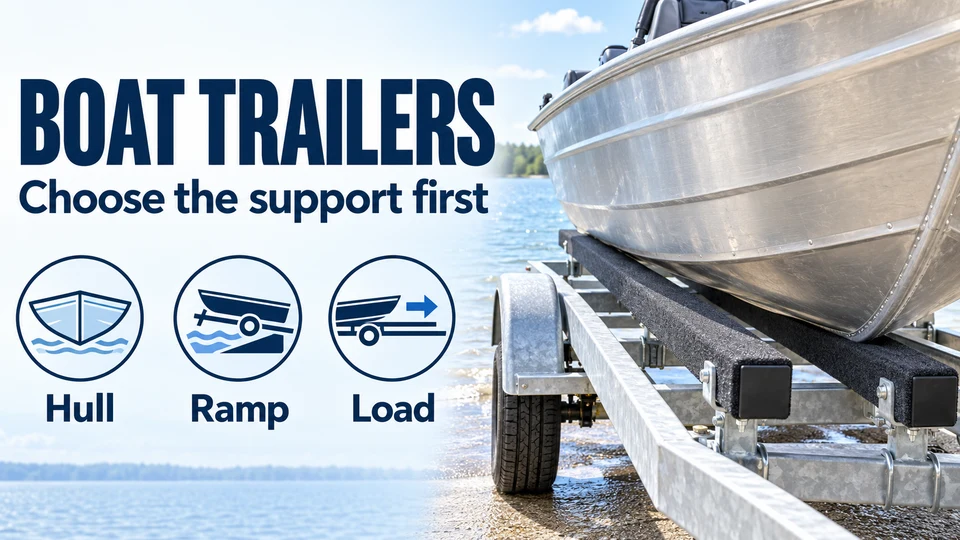
Record the boat, trailer and launch site together
For repeated road towing of a pontoon, start by assessing a correctly fitted bunk trailer. For an aluminum fishing boat, compare bunks with rollers only after the boat supplier confirms the permitted support arrangement. A scissor trailer needs its own deck-support, clearance and road-use assessment; shallow-water convenience cannot settle those questions. Use this checklist alongside delivery planning to record what the proposed package includes and what still needs a written answer.
| Input or item | Value or source to record | Why it matters |
|---|---|---|
| Boat support | Exact hull or tube layout and supplier-approved support drawing | Defines where the trailer may carry the boat |
| Loaded package | Boat with motor, fluids and gear; actual empty trailer weight | Dry hull weight leaves out towing load |
| Trailer and vehicle | Labels, fitted equipment and applicable owner manuals | Identifies gross, axle, hitch and payload limits |
| Ramp and use | Low-water conditions, ramp end, slope, surface and towing route | Tests whether the fitted package suits your normal trip |
Which trailer type belongs on your shortlist?
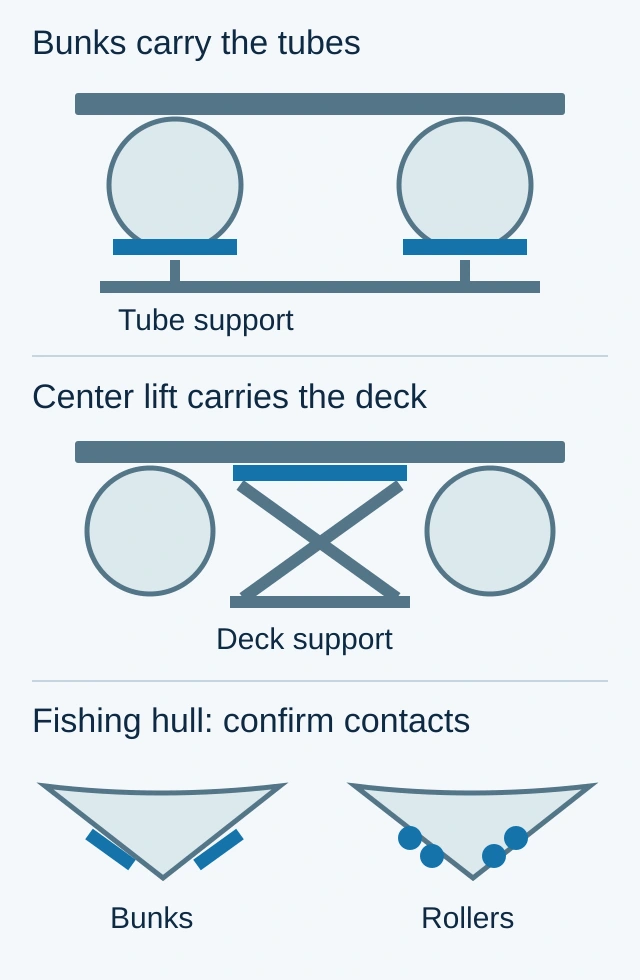
Shortlist by boat structure, then compare launch access. Bunks spread support along boards; rollers support the hull at individual contacts and reduce sliding resistance. A conventional pontoon scissor trailer carries the boat through the underside of its deck rather than through bunks beneath the tubes. These are different load paths, not interchangeable accessories.
| Trailer route | Support and likely use | Ramp tradeoff | Dominant Failure Mode & Prevention |
|---|---|---|---|
| Pontoon bunk | Lengthwise bunks beneath the tubes; starting point for frequent road travel | Usually needs more immersion for float-on/float-off use | Misplaced or incomplete tube support: obtain tube spacing, supported length and fitted-trailer approval |
| Pontoon scissor / center lift | Narrow lifting frame between tubes supports approved deck structure; assess the specific transport use | Can lower the support height, helping some shallow launch or storage situations | Lateral instability or wrong deck contact: require road-use suitability and approved contact points; do not assume a third tube will clear |
| Fishing-boat bunk | Longitudinal boards positioned for the approved hull structure | Float-on/float-off access may require backing farther in | Unsupported stern or concentrated hull loading: verify support length, board position and transom support |
| Fishing-boat roller | Multiple roller contacts, only where the hull supplier permits them | May need less trailer immersion than a comparable bunk arrangement | Unsuitable contact locations or uncontrolled boat movement: confirm roller layout and the manual's restraint and launch procedure |
A shallow ramp is a reason to investigate another approved arrangement or another launch site. It is not a reason to substitute rollers or a center lift without hull approval. Do not infer towing suitability from axle count alone.
Confirm the support points before ordering
Ask the boat and trailer suppliers to agree on the support layout for the complete configuration. For a pontoon, record tube count, tube shape, center spacing, supported length and clearance to the engine pod, strakes and under-deck fittings. For an aluminum fishing hull, request the permitted bunk or roller positions and the required stern, transom and keel support. A keel roller may be part of an approved arrangement; its presence does not establish that the keel should carry the entire load.
Conventional center-lift designs need clear space between the tubes and suitable deck structure to bear the load. A center tube or other equipment can occupy that space. Keep the scissor option pending until both suppliers confirm fit and transport suitability for the exact boat.
Obtain the fitted-trailer record with support positions, winch/bow-stop arrangement and securement points. Have the responsible provider perform adjustments using the applicable manuals. A boat length or photograph cannot establish those settings.
Check ramp depth as a site condition
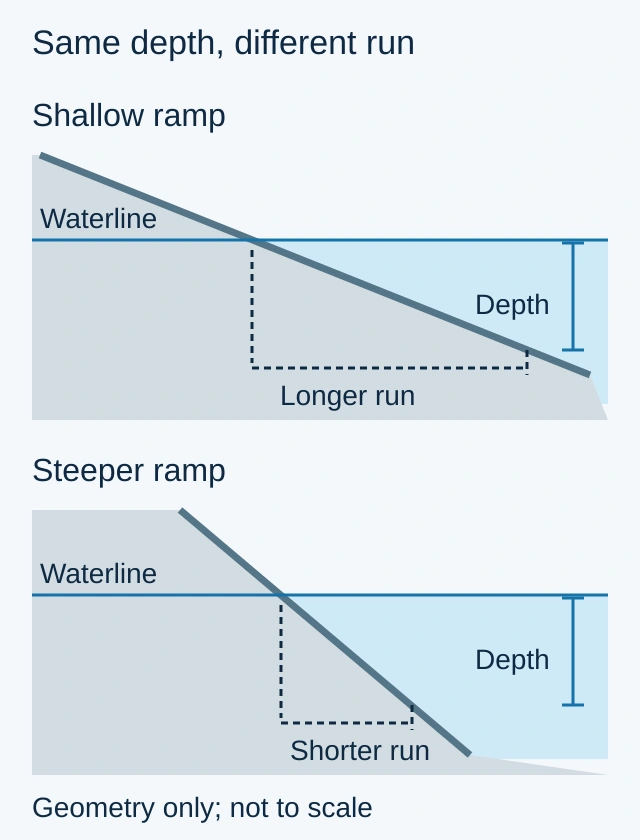
There is no universal launch depth for a bunk, roller or scissor trailer. Support height, hull draft, ramp slope and water level change how far the trailer must enter. A shallower slope uses more ramp length to reach the same depth, so record the usable ramp end at the lowest water level you expect. Ask the local operator and handover provider to confirm a suitable launch method for the fitted package.
| Ramp check | Record before choosing | Hold the launch plan if… |
|---|---|---|
| Low water and ramp end | Expected water level, usable ramp length and submerged drop-off location | Required access or the ramp end remains unknown |
| Surface and approach | Local assessment of traction, slope changes and approach/turning space | The tow vehicle or trailer cannot use the approach within its instructions |
| Support height and draft | Fitted trailer dimensions and the loaded boat's launch requirements | Adequate water cannot be reached within the usable ramp |
| Wind, current and rules | Site restrictions, assistance and the manual-based recovery method | Conditions or the permitted method exceed the agreed plan |
Do not use fender submersion as a universal depth gauge. Agree when and how restraints are released with the handover provider using the fitted trailer's instructions, especially with rollers. Confirm whether the site permits power loading rather than assuming it does.
Calculate loaded weight, then check every rating
Pontoon boat towing weight includes the trailer and the boat as it travels, with the selected engine, batteries, fuel, water and gear. Request a measured ready-to-travel boat weight or a fully defined weight build-up. Count each item once: if an engine or battery is already in the supplied figure, do not add it again. Use the buying process checklist to keep the final written configuration tied to that weight record.
Loaded trailer gross weight = ready-to-travel boat weight + actual empty trailer weight. Hypothetical worksheet inputs: 2,400 lb + 700 lb = 3,100 lb loaded gross. If that example trailer's applicable GVWR were 3,500 lb, its arithmetic gross-weight margin would be 3,500 − 3,100 = 400 lb. These assumed figures describe no SEAVIA model, recommended margin or approved towing combination.
GVWR includes the trailer itself; a carrying-capacity figure describes the load it can carry. Do not compare a complete loaded trailer directly with a payload-only advertisement. Record the actual trailer's applicable GVWR, carrying capacity, axle ratings and tire ratings, then have the provider verify the loaded arrangement.
Selection rule: if measured loaded trailer gross exceeds the applicable trailer GVWR or the vehicle's permitted trailer weight, exclude that combination. If the gross-weight subtraction is zero, no allowance remains for an additional item; a positive result still leaves axle loads, tongue load, vehicle payload and support fit to resolve.
| Separate towing check | Evidence to obtain |
|---|---|
| Tongue load | Actual loaded measurement and compatible trailer/vehicle instructions; do not apply an internet percentage universally |
| Vehicle payload and axles | Allowance for occupants, cargo, accessories and tongue load; loaded axle and vehicle weights checked against the labels |
| Combined and trailer limits | Exact vehicle configuration's towing manual and loaded scale record, including gross combined rating where specified |
| Connection equipment | Compatible receiver, ball mount, ball and coupler ratings, plus brake/control compatibility |
Tongue load consumes tow-vehicle payload; it is also part of the trailer's gross weight, so do not add it again to the loaded-trailer sum. Have the scale operator or qualified provider explain how the measured axle and tongue loads reconcile. If vehicle and trailer instructions conflict, resolve the combination with the suppliers before towing.
Use this towing and handover checklist
Ask the handover provider to demonstrate the checks for your fitted trailer and record who resolves each open item. Use the boat trailer winch checklist to compare rated pull, strap condition and seated bow-stop alignment. This checklist identifies what to verify; adjustment settings, restraint sequence and operating instructions belong to the selected boat, trailer and tow vehicle manuals.
| Check | Record or demonstrate | Before acceptance |
|---|---|---|
| Support and securement | Approved support contact, bow/winch setup, tie-down locations and outboard transport instructions | Named provider confirms the fitted arrangement; winch line alone is not a tie-down |
| Coupling and brakes | Matched connection, latch, safety chains and applicable breakaway/brake controls | Provider demonstrates connection and required functional checks |
| Running gear and lights | Tire condition/pressure, wheel and bearing checks, lights and wiring per manuals | Obtain service records, fitted manuals and maintenance responsibility |
| Loaded weighing | Travel inventory, loaded gross, tongue and vehicle/axle readings | Keep the readings with applicable rating labels and configuration |
| Route and launch | Destination road requirements, clearances, ramp access and permitted launch method | Resolve local requirements and site constraints with the responsible parties |
| Delivery scope | Trailer supply, setup, transport, unloading and handover inclusions | Mark included, excluded, buyer-supplied or pending in the written quote |
Compare ownership costs over the same period
Compare fitted packages over the same ownership period, using the same launch count and towing route. A lower acquisition amount can leave setup, storage or a different launch arrangement outside the quote. The delivery checklist helps assign those costs to the right party before comparing totals.
Same-period trailer cost = purchase and setup + scheduled care + support-part replacements + storage and transport + additional launch/recovery costs − documented resale proceeds. Keep uncertain amounts pending. Use the fitted manuals and local quotes for service and replacement assumptions rather than assigning a generic lifespan to bunks, rollers or bearings.
Include your time separately. For a hypothetical five-season comparison, 12 launches per season × 5 seasons × an assumed 10 additional minutes per launch = 600 minutes, or 10 hours. Enter a time difference only if your own site assessment supports it; this example predicts no trailer's speed or savings. Compare that time with the actual costs of using another suitable ramp or arranging transport.
- List bunk covering/boards or roller assemblies and the labor to inspect and replace the fitted parts.
- Budget manual-based bearing, tire, brake and corrosion care for the actual water exposure and storage conditions.
- Include another setup visit, local transport or a different launch site if the proposed arrangement cannot meet your use.
What to send us
Send your boat interest, destination and completed trailer notes on WhatsApp to discuss the configuration and quotation scope. The buying guides can help if you are still deciding between boat types. Ask the final supplier to identify the trailer offered, its inclusions and the party responsible for fitment and local handover; this guide does not establish trailer availability for your region.
| Item | Why we need it | Example format |
|---|---|---|
| Boat and support | Identifies the intended configuration | Model or intended use; tube/hull layout; supplier drawing if available |
| Weight and vehicle | Makes the towing question specific | Weight definitions or scale record; trailer labels; exact tow vehicle and manual limits |
| Ramp and travel | Explains access constraints | Ramp name/location, low-water notes, photos, route and towing frequency |
| Destination and scope | Separates supply from local work | Country/region; trailer included or buyer-supplied; setup and handover requested |
Opening WhatsApp prepares a draft. Review and send the message there to share your request; equipment fit, regional supply and the written package still need confirmation.
Method and sources
Sources checked October 20, 2026. This checklist combines OEM descriptions of trailer support with the currently linked ShoreLand'r Trailer Owner's Guide, Rev L dated May 3, 2021, and vehicle-manual load definitions. Obtain the applicable current documents for the equipment actually offered. The diagrams describe relationships, not installation dimensions. The load and time examples use hypothetical inputs.
The 2025 published edition of 49 CFR 571.3 supplies rating terminology only. Brake, equipment and transport requirements vary by destination and route; no legal weight threshold or compliance approval is assigned here. A trailer category, illustration or catalog capacity cannot approve an individual boat-and-vehicle combination.
- ShoreLand'r: bunk and roller support and ramp characteristics
- ShoreLand'r Trailer Owner's Guide, Rev L (May 3, 2021): matching, loads, securement and handover
- Tahoe owner resource: pontoon bunk and scissor support layouts and towing tradeoffs
- Ford 2020 Expedition manual: tongue load and vehicle payload definition
- 49 CFR 571.3, published 2025 edition: GVWR and GAWR definitions