
Trailer winch guide
Boat Trailer Winch: Capacity, Strap, and Bow Stop
Updated
Choose a boat trailer winch by matching its rated pull to the complete loaded boat and the conditions in which you retrieve it. Then check the strap’s approved winch capacity, condition and attachment, and the seated bow-eye position against the bow stop. Handle effort alone cannot establish a suitable setup.
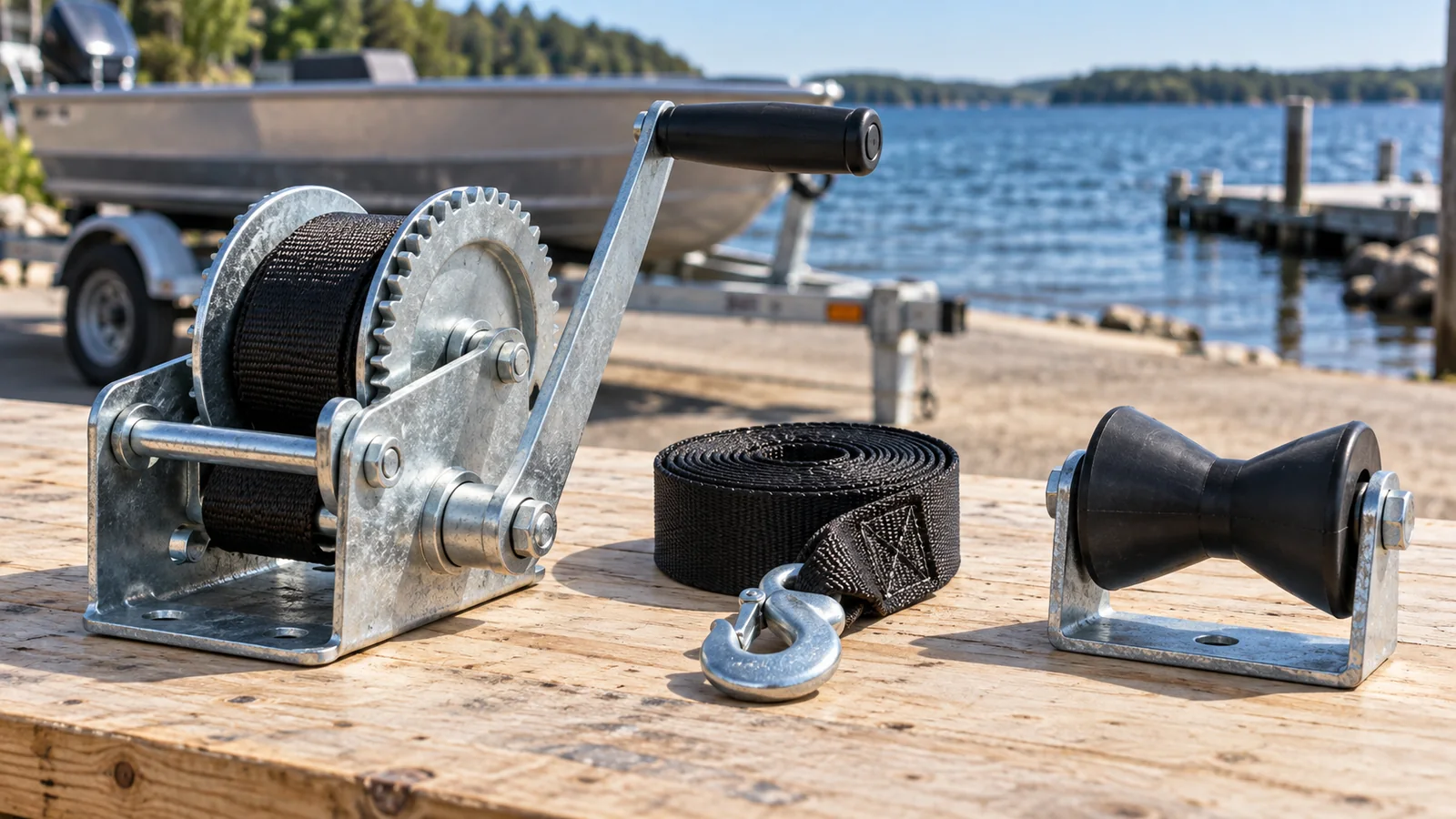
Start with the boat, the label and the loading conditions
For a replacement winch or a new trailer package, collect the checks below before comparing products. Record the boat’s engine, fuel, batteries, water and equipment in its loaded weight. Keep empty trailer weight separate: it belongs in the towing calculation, while the winch pulls the boat onto the trailer. For the wider package decision, browse our boat buying guides.
| Check | Record | Decision it supports |
|---|---|---|
| Boat and retrieval | Loaded boat weight, support type, ramp slope, flotation and pull distance | Select capacity using the winch maker’s application guidance |
| Winch label and manual | Exact model, rated pull, drum-layer basis, line reserve and gearing | Compare ratings on the correct basis |
| Strap and hook | Approved winch capacity, width, length, attachment and condition | Choose a compatible replacement and remove damaged line |
| Seated bow | Side view of bow eye, stop, line and separate safety connection | Check the trailer’s specified alignment and restraints |
How much boat trailer winch capacity do you need?
Use the winch manufacturer’s selection guidance for your loaded boat and retrieval conditions. A boat floating most of the way onto well-maintained rollers presents a different pull from a long retrieval on bunks. If support choice is still open, use the bunk, roller and scissor trailer comparison to settle the boat’s support arrangement first.
Dutton-Lainson’s Hand Winch Selection Guide illustrates how conditions change its boat-weight-to-winch-capacity guidance. The ratios below mean boat weight divided by winch capacity. Apply the instructions for the exact winch and trailer; the guide calls for special consideration for pontoon trailers and other special designs.
| Dutton-Lainson guidance | Boat weight : winch capacity | Conditions attached to the example |
|---|---|---|
| Common starting example | 2:1 | Its guide pairs a 2,200 lb boat with a 1,100 lb winch, then requires consideration of the loading conditions |
| Lower-resistance retrieval | Up to 3:1 | Free-turning rollers in excellent condition and a ramp where the boat floats most of the way onto the trailer |
| More demanding retrieval | As low as 1:1 | Wooden bunks without self-alignment and a long winching distance; its FAQ also identifies steep ramps |
Read the drum conditions as carefully as the capacity number. The Dutton-Lainson DLx manual, document 206430, rates that winch with three layers of line on the hub and separately requires at least three full turns to remain on the reel. Layers describe how line builds outward on the drum; turns describe the reserve left when line is extended. Use your model’s own instructions for both.
What does the winch gear ratio change?
Gear ratio changes the tradeoff between handle effort and retrieval speed. In Dutton-Lainson’s FAQ example, 4:1 means four complete handle turns for one drum revolution. A low-speed setting provides more mechanical advantage; the winch’s rated capacity still controls the load.
A two-speed winch can make a demanding pull easier to manage, but its shifting method and ratchet operation depend on the model. Read those instructions before use. If the load becomes unexpectedly hard to move, stop and check the boat’s support, line routing and loading conditions instead of forcing the handle.
Check ratchet operation and mounting condition before use. The DLx manual instructs users to stop using a damaged ratchet and obtain repairs. A longer handle or an easier gear is not a remedy for damaged hardware or a misaligned boat.
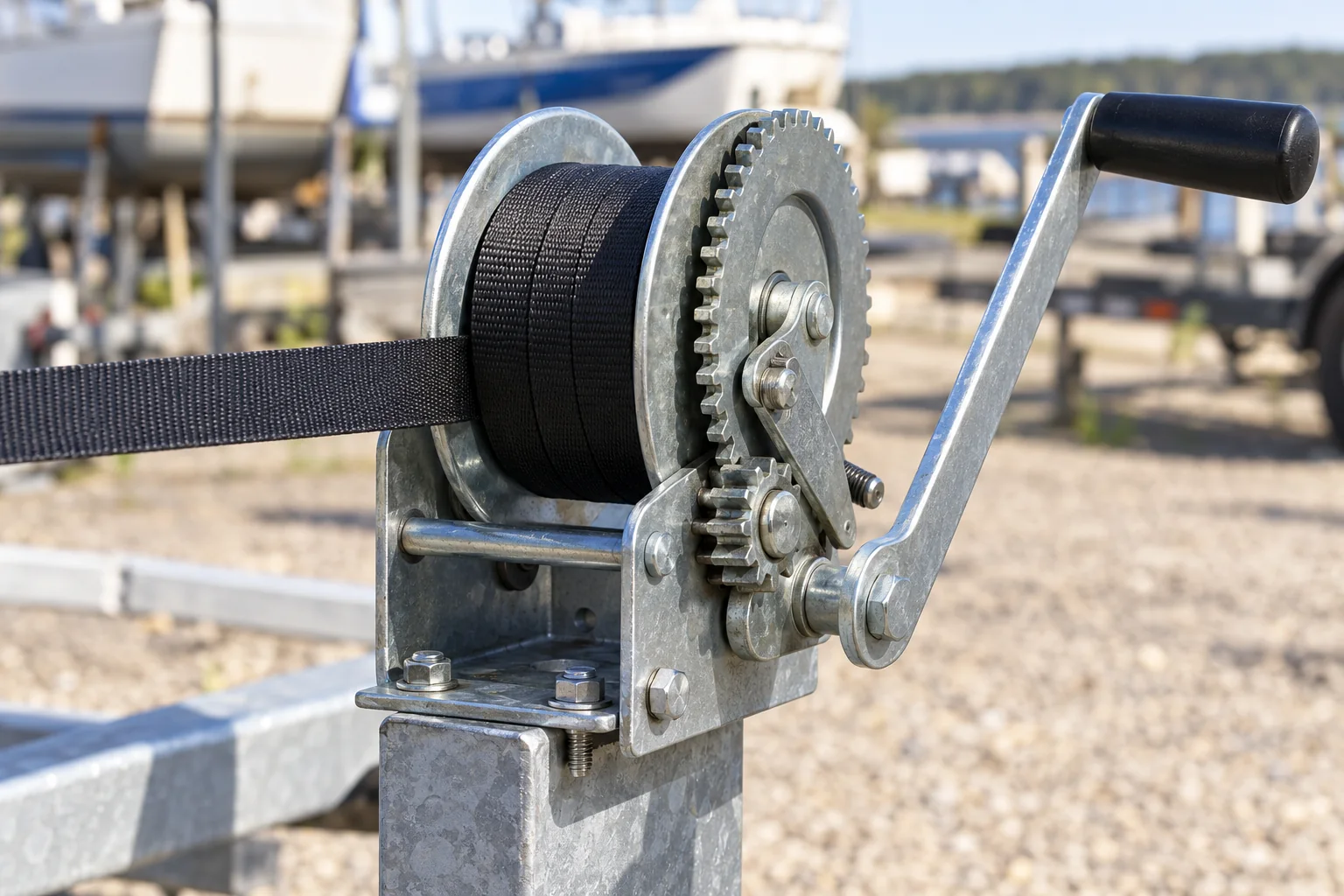
Match a trailer winch strap by more than breaking strength
Choose a replacement strap by the winch maker’s compatibility rating, width, usable length, drum attachment and hook fit. Breaking strength and the stated capacity of the winches a strap can serve describe different limits. Compare the matching columns, then check that the replacement attaches and winds as the manual requires.
Dutton-Lainson’s Winch Straps specification table gives the following two examples. Both straps are 2 inches wide, yet their approved winch-capacity ranges differ. The 6148’s 2,600 lb breaking-strength figure does not make it suitable for a 2,600 lb winch; its listed application is winches up to 1,700 lb.
| Dutton-Lainson strap | Listed size | For winches up to | Breaking strength |
|---|---|---|---|
| 6148 | 2 in × 15 ft | 1,700 lb | 2,600 lb |
| 6156 | 2 in × 14 ft 8 in | 2,600 lb | 4,000 lb |
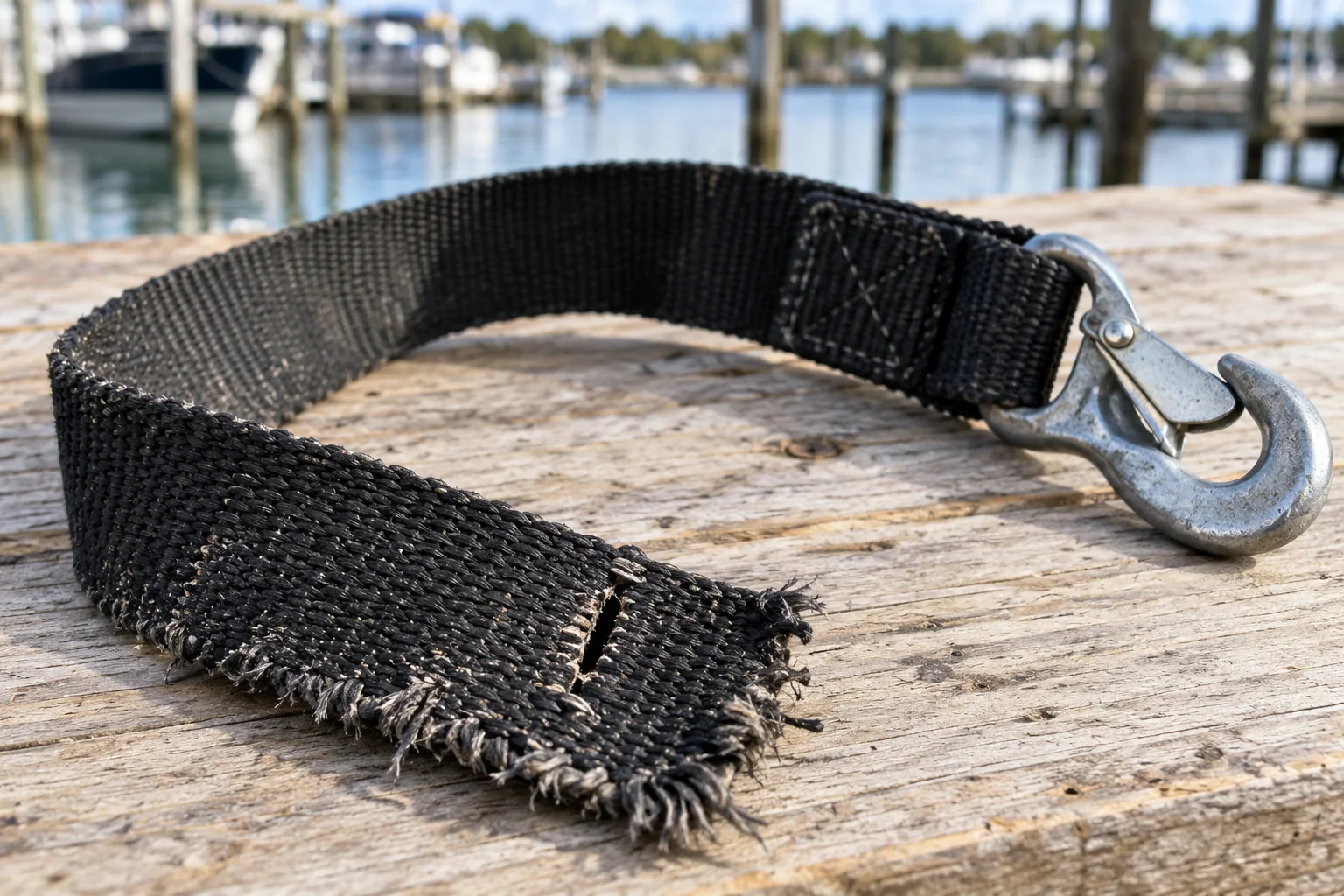
EZ Loader’s 2024 adjustable-trailer owner’s manual, page 12, directs owners to replace a line, strap or cable immediately if it has fraying, cuts or tears. Do not assign a reduced working rating to damaged webbing. Secure the boat using the prescribed restraints and unload the line before inspecting or replacing it; follow the winch’s attachment procedure for the new strap.
Check the boat trailer bow stop with the bow fully seated
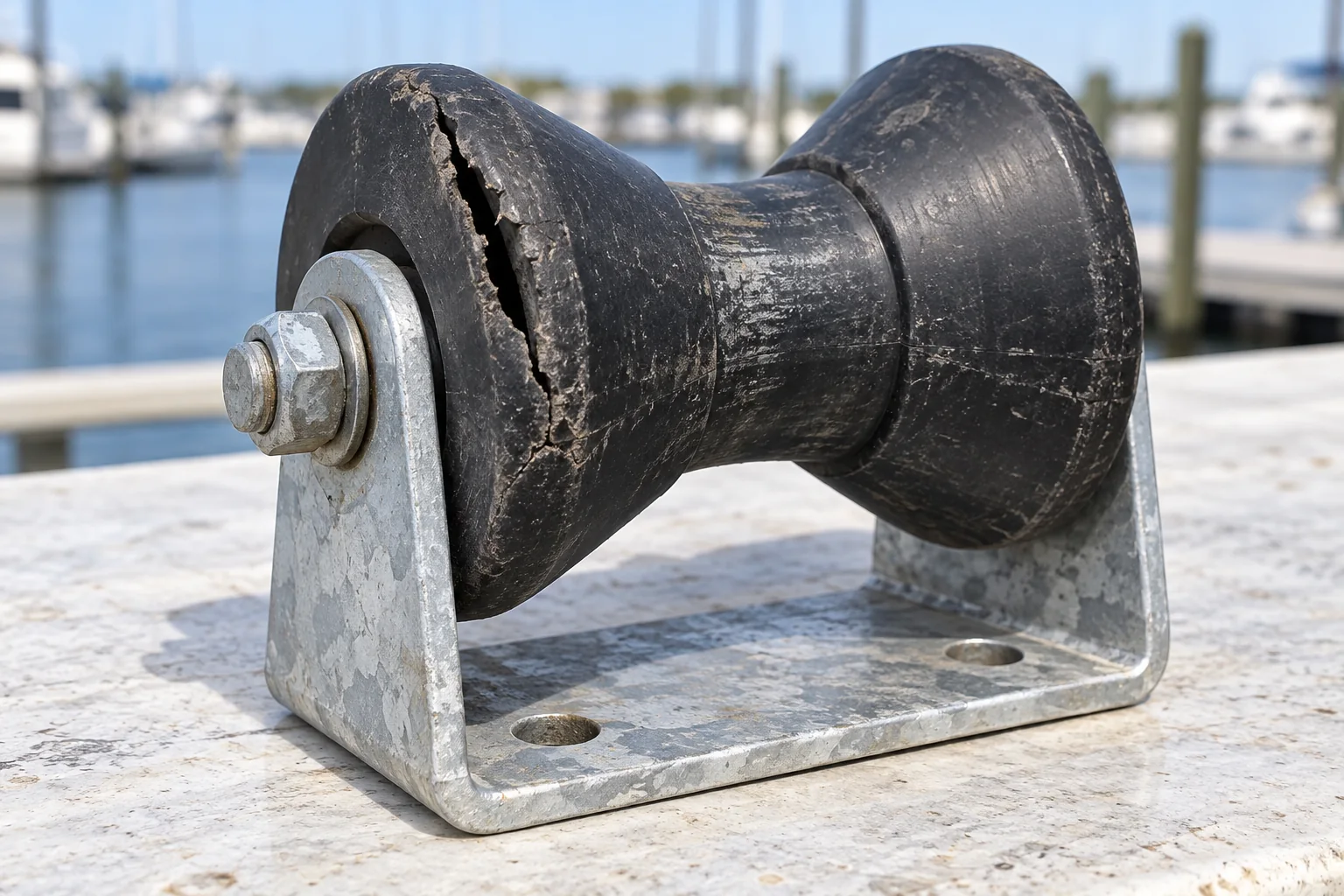
Check the bow eye, stop and winch-line relationship with the boat resting in its intended position on the trailer. EZ Loader’s adjustable-trailer manual, page 13 and Figure 6, specifies a level pull at the bow eye, with the stop roller or vee block just above it. In that arrangement, the bow eye seats snugly beneath the stop, and the pull does not lift the bow or drag it downward.
Use the approved arrangement for your own hull or pontoon bow. Look for a clear line path, appropriate stop contact, secure stand mounting and serviceable roller or vee-block material. A cracked stop, loose bracket or visible movement under load needs correction before relying on the setup. Have the trailer provider resolve alignment or mounting changes using the boat and trailer instructions.
Bow-stop routing and drum winding are separate checks. Dutton-Lainson’s FAQ explains that whether the line winds over or under the reel depends on the winch model and its ratchet or brake arrangement. Follow that winding direction while keeping the line clear of sharp edges and rubbing against other winch parts.
For pontoon approach alignment, the guide-on fit checklist covers tube clearance and guide placement. Keep that check alongside the winch and stop setup when reviewing the trailer package.
Can the winch strap hold the boat during towing?
Use the boat and trailer’s prescribed tie-downs and separate bow safety connection before towing. EZ Loader’s manual, page 12, expressly warns against depending on the winch line, strap or cable alone to hold the boat secure. The bow safety chain connects the boat to its trailer; the trailer-to-tow-vehicle safety chains serve a different connection.
After retrieval, complete the restraint sequence in the trailer manual and check that the boat is properly seated. If it can still rock on the trailer with the winch line and tie-downs tight, EZ Loader directs owners to check the bunk or roller settings and winch adjustment. More strap tension is not a substitute for correcting support fit.
At the next launch, follow the fitted trailer’s instructions for when and how to release each restraint. Keep the operating sequence with the handover documents so everyone handling the boat uses the same procedure.
Bring these details to a SEAVIA package discussion
To discuss a SEAVIA boat and trailer package, collect the loaded boat weight and how it was established, the winch model and gear ratios, and clear photos of the strap and seated bow. Use delivery planning to keep the equipment list, manuals and handover responsibilities together. For a pontoon, add the guide-on fit checklist when approach alignment also needs attention.
- Weight and use: loaded boat weight, engine and equipment included, normal ramp, support type and approximate retrieval distance.
- Winch identification: label and manual, capacity and drum-rating basis, gear ratio or speed settings.
- Strap details: width, length, compatibility rating, drum attachment, hook and any damaged areas.
- Seated-bow view: side photo showing the bow eye, stop, line path, winch stand and separate bow safety connection.
Open the WhatsApp draft below, add your package details and send your message. Keep the final equipment selection and setup instructions with the written package specification.