
Fishing boat layout comparison
Center console vs. dual-console soft-top fishing boats: layout checklist
Updated
The wrong layout can leave your fishing route blocked or your passengers short of the cover they wanted. Start with a center console for movement around the helm, or compare a dual-console soft-top aluminum fishing boat when helm shelter takes priority. This 18–21 ft checklist separates deck access, cover and measured length before you request a quotation.
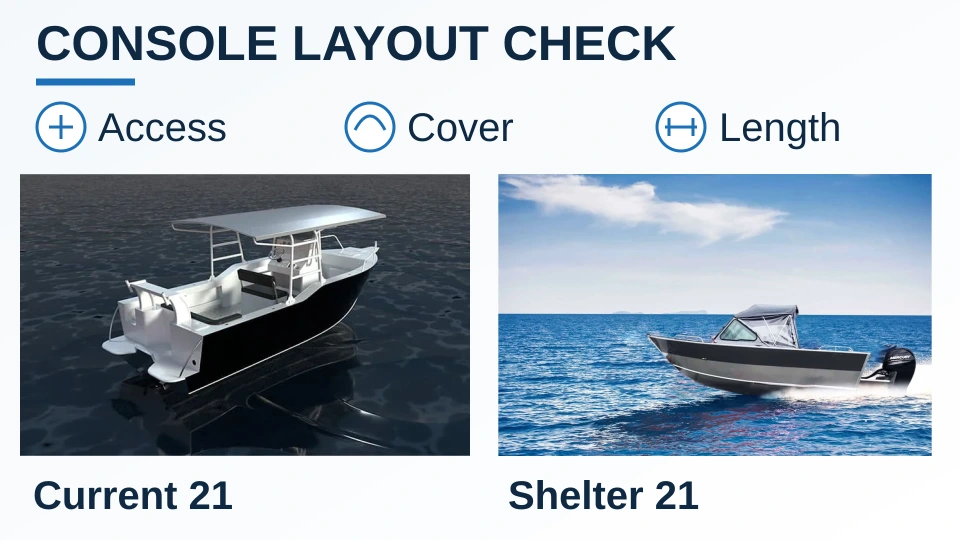
Record the inputs before comparing boats
A 21 ft center console boat and a 21 ft soft-top boat can carry different length labels and very different working layouts. In the SEAVIA fishing range, Current 18 and Current 21 put the helm centrally; Shelter 21 uses dual consoles and a soft top. Compare the route between fishing positions and the cover needed at the helm, then confirm dimensions on the selected configuration drawing. Neither a model number nor a top establishes usable deck area or an operating rating.
| Input or item | Value or source to record | Why it matters |
|---|---|---|
| Fishing routine | Crew positions, rods, landing net and tackle | Reveals which routes must stay usable |
| Seats and storage | Drawing with seats deployed and gear secured | An empty-deck view can conceal conflicts |
| Helm cover | Top, windscreen and side-panel scope | Shade and an enclosed cabin are different requirements |
| Length basis | Hull, overall and stored-package dimensions | Prevents comparing unlike measurements |
| Destination | Country/region, storage limits and intended use | Frames configuration and supply review |
Compare access and shelter on the same terms
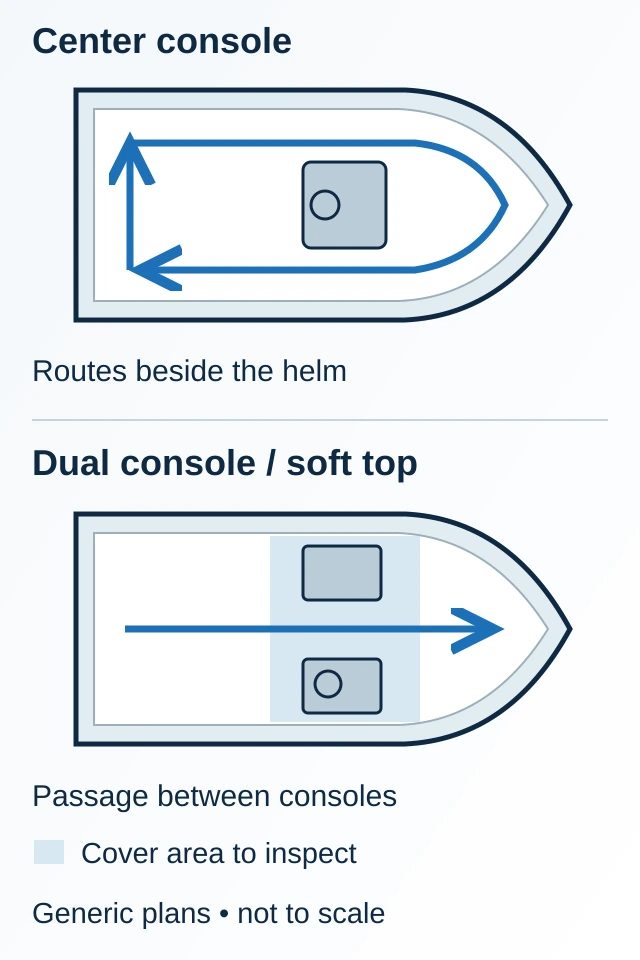
Choose the layout whose installed arrangement supports your normal outing. The center-console advantage is the potential route on both sides of the helm; the dual-console trade is a more defined helm area with a passage to inspect between the consoles. Actual seats, supports and stored equipment decide whether those routes work. The aluminum fishing boat buying guide covers the broader engine, equipment and destination questions after this layout check.
| Layout | Start here when | Inspect before choosing | Dominant Failure Mode & Prevention |
|---|---|---|---|
| Center console: Current 18 / Current 21 | Reaching bow and stern fishing positions matters more than a sheltered helm enclosure | Both side routes, console seat, top supports, storage lids and net handling | A cooler or seat interrupts the intended loop: mark all carried items on the drawing and check the narrowest points. |
| Dual console / soft top: Shelter 21 | Cover at the helm matters and the working cockpit suits your fishing routine | Between-console passage, windshield/door arrangement, top frame and seats folded/deployed | Canvas, an open door or a seat conflicts with access: review each agreed use position on the selected layout. |
| Cabin / walkaround category | An enclosed space or overnight facilities are essential | Actual cabin amenities and the route around it on a specific boat | A soft-top label is mistaken for a cabin specification: require the enclosure and facilities on the equipment list. |
Walk the deck with the gear you actually carry
A useful casting route must remain usable with your crew, seating and secured gear in place. Start the Current 18 check at the compact central helm; use the Current 21 reference overview to discuss the bow and stern working areas. Trace a full circuit on the drawing rather than assuming the words center console guarantee unrestricted 360-degree fishing access.
For a straight-pass geometry check, remaining width = clear opening − carried object width, measured in the same orientation. With explicitly assumed inputs of a 480 mm opening and a rigid 500 mm cooler, 480 − 500 = −20 mm: the cooler cannot pass straight through that opening. If the result is zero or negative, change the object, stowage route or layout before shortlisting it. A positive result alone does not establish comfortable or safe human access; body movement, handholds and the actual boat still need review.
- Mark each person’s fishing position and the route to the bow, stern, helm and boarding point.
- Place the cooler, tackle, net and stowed rods on the plan. Check whether a person retrieving gear blocks another person’s route.
- Check the console-side or between-console opening at its narrowest point, including fittings and top supports.
- Review seats deployed and folded, and show how storage lids and doors open. Confirm which positions the supplier permits during use.
- Ask for the selected arrangement’s dimensions and close-up views before accepting an unresolved route conflict.
Separate overall length from hull length
Shelter 21 has two distinct published reference figures: 21 ft overall and 18.5 ft hull length. Current 18 lists a 5.5 m reference model length and Current 21 lists a 6.3 m reference model length. The Current figures do not establish the same measurement basis as either Shelter figure. Ask for a current drawing with the endpoints identified; keep the reference figures separate until the selected configuration is confirmed.
Convert units without changing the measurement: length in metres = length in feet × 0.3048. Using Shelter’s published reference figures, 21 × 0.3048 = 6.4008 m overall, while 18.5 × 0.3048 = 5.6388 m hull. The reference difference is 21 − 18.5 = 2.5 ft, or 0.762 m. That difference does not identify extra cockpit space or tell you which fitting accounts for it.
For storage, use the complete package envelope in the agreed engine, top and trailer positions. A boat’s reference length leaves those questions open. The garage fit checklist records the outside package and access dimensions together.
| Model | Existing SEAVIA reference | What to request |
|---|---|---|
| Current 18 | 5.5 m model length | Dated hull and overall dimensions, with included equipment identified |
| Current 21 | 6.3 m model length | Current drawing and revision; confirm measurement basis before comparing |
| Shelter 21 | 21 ft overall; 18.5 ft hull | Endpoints for each figure and separate usable-deck dimensions |
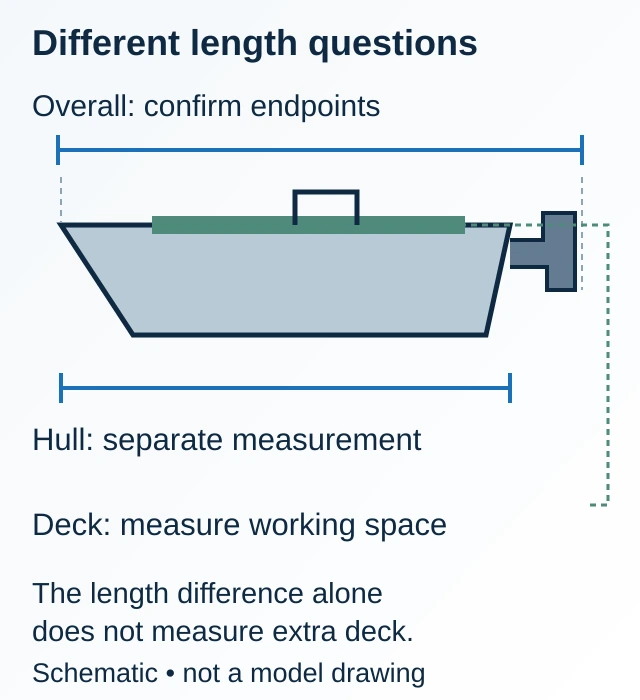
Request hull length for a hull comparison, measured working dimensions for a deck comparison, and the complete stored envelope for a fit check.
Specify the cover, cabin or walkaround you need
Shelter 21 is the soft-top, dual-console reference in this shortlist. If an aluminum fishing boat with cabin is on your list, spell out whether you mean helm shade, a windshield with side panels, or a fully enclosed space with particular facilities. Ask for every required part on the quotation; a supplier image does not establish which windshield, canvas or seating arrangement is included.
A walkaround layout typically routes people around a cabin, whereas a center console leaves routes beside the helm. If you need an enclosed cabin or berths, evaluate a boat documented with those features. The Shelter soft-top description does not establish sleeping accommodation, a head or a fully enclosed cabin.
Check helm visibility, reach to controls and passage access in the agreed top and panel positions. Treat shelter and operating suitability as separate questions. Wind, wave, loading and engine limits come from the selected boat and equipment documents, not the console category or a 21 ft label.
Compare the complete package over the same ownership period
Compare itemized offers for the same equipment scope and destination, then use the same ownership period for each layout. A lower boat-only figure can omit a top, windshield, engine rigging or trailer you actually need. Review how buying works before treating a preference or reference image as an approved package.
Planning total over N years = delivered purchase + storage/insurance/registration over N years + fuel/maintenance over N years + top/panel upkeep and replacements over N years − expected resale at year N. Use dated local quotes, the same usage assumptions and a clearly identified resale assumption. Leave missing values pending. No layout has a proven cost advantage until those inputs are comparable.
| Cost or task | Keep the comparison consistent | Hidden omission to prevent |
|---|---|---|
| Installed equipment | Same engine, rigging, fishing equipment and trailer scope | Buying hardware or installation later that the first offer excluded |
| Cover and storage | Actual top, panel and cover scope; same storage period | Canvas cleaning/drying, replacement and storage-height constraints left out |
| Ownership use | Same destination, usage estimate and ownership years | Comparing one season of upkeep with several years of another package |
| Support and resale | Named support responsibility and explicit resale assumption | Assuming local service or a guaranteed resale value |
What to send us for the layout discussion
Send your shortlist, fishing routine, cover requirements and destination through WhatsApp. Include any drawing or dimensions you already have, and list unresolved fields as questions. We can discuss the model and configuration direction and confirm the next quotation and regional-supply steps. Opening the WhatsApp draft does not send your message or reserve a boat.
| Item | Why we need it | Example format |
|---|---|---|
| Shortlist and length basis | Keeps model references separate from the requested measurements | Model names; hull/overall dimensions or request for drawing |
| Crew and fishing routine | Identifies routes and working positions to discuss | Annotated plan with seats, cooler, rods and net |
| Cover requirement | Separates shade from enclosure and cabin facilities | Top/windscreen/side-panel needs, each listed separately |
| Storage and package scope | Frames fit and included-equipment questions | Measured limits, engine/trailer preferences and missing dimensions |
| Destination and budget basis | Frames availability and a comparable offer | Country/region; currency; delivered-package scope; ownership period |
Method and sources
Checked 20 October 2026. The model names, layouts and qualified length figures above follow SEAVIA’s published reference records. Confirm the current configuration and measurement drawing before ordering. Discover Boating’s layout explanations support the general access, windshield and walkaround distinctions; they do not establish equipment or operating limits for these models. Return to buying guides for the related selection steps, or use the garage fit checklist to record a complete stored package.
ISO 8666:2020, Small craft — Principal data, concerns principal dimensions, mass data and loading conditions for craft with hull length up to 24 m. ISO’s public entry records confirmation in 2026. Its public abstract supplies context here, not a model measurement certificate or a detailed endpoint rule. Ask the supplier to state the method used for your drawing. The access and length schematics explain questions to check; they contain no measured model clearances.