
Pontoon Canopy & Clearance Guide
Pontoon Bimini: Frame Width, Height, and Fold Clearance
Updated
Ordering a pontoon bimini or replacing a damaged canopy requires matching frame mounting width between the two opposing rail mounting points, standing headroom beneath the bows, and front-to-back canopy length.
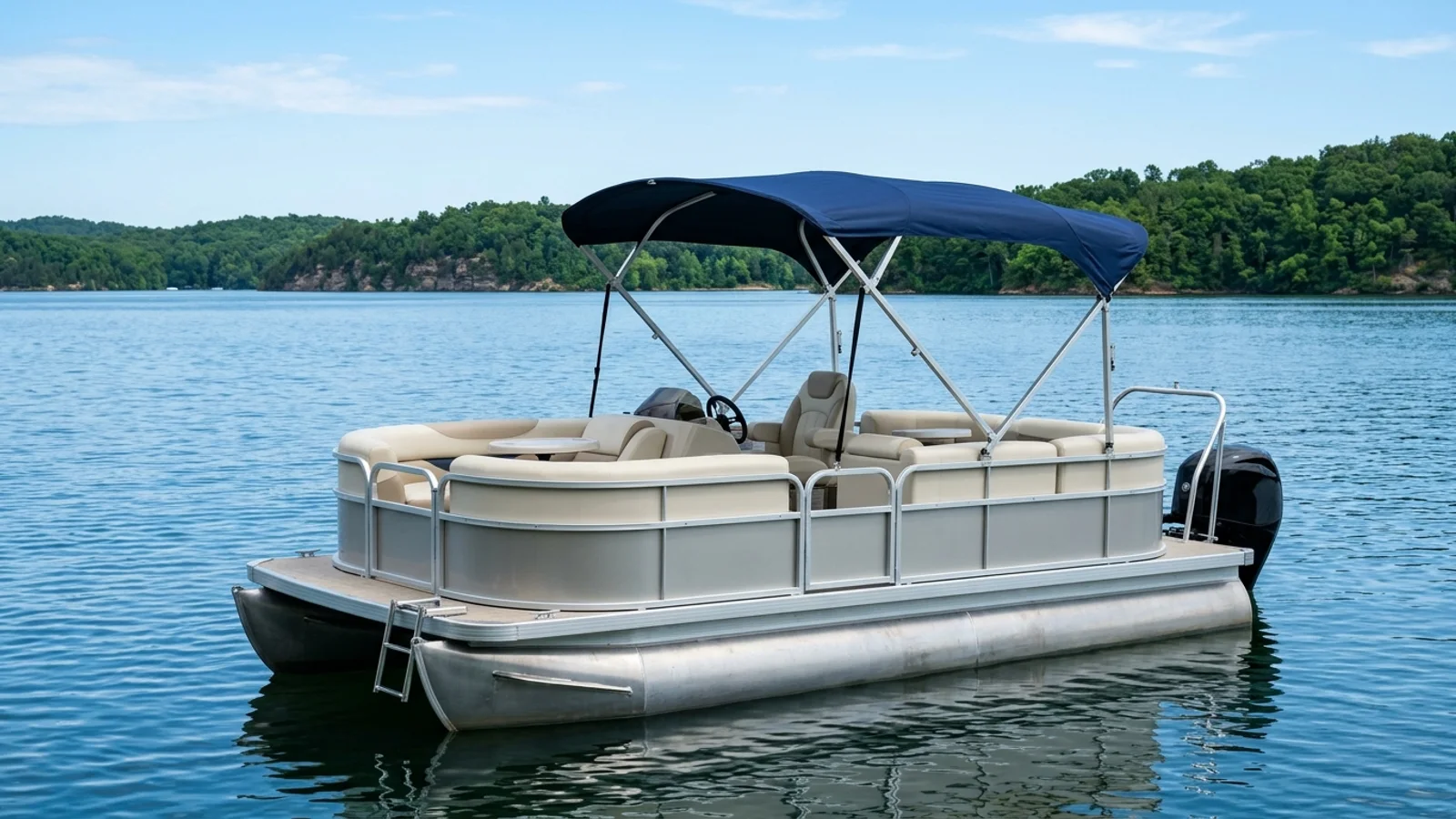
How Pontoon Fence Width and Beam Govern Bimini Frame Sizing
As covered across our boat buying and ownership guides, the 16ft Entertainment Series pontoon platform has a 5m hull length, a 6-8 passenger capacity, a 2.3m beam, and a 60HP power rating. Stepping up to the 22ft Entertainment Series platform increases length to 6.8m for 8-10 passengers with 2.3m or 2.6m beam options and a 115HP rating. The 24ft Entertainment Series platform extends hull length to 7.2m for 8-10 passengers with 2.3m or 2.6m beam choices and a 115HP rating. In our pontoon floor plan and beam comparison, the outside width difference between a 2.3 m and 2.6 m beam is 0.30 m (300 mm), while the usable central aisle also depends on inner fence position, furniture depth, and helm footprint.
Across 16ft, 19ft, 22ft, 24ft, and 25ft Entertainment Series configurations, the aluminum pontoon tubes share a 0.5m diameter and 0.8mm wall specification beneath the deck structure. Before assembling the frame or drilling into the pontoon fence, installers should verify that the top dimensions match the boat rail layout. Aluminum bimini frames flex slightly to expand or retract to the exact rail width when one side is mounted first and the opposite bow is pushed or pulled into its hinge with minimal force.
For standard square-tube pontoon rails that fit 96″ or 102″ beams, the Carver Standard Square Tube Pontoon Top (8SQ)4893 on Frame 50510 is built at 48″ height and 8 FT length. At the same 48″ height and 8 FT length, Carver also offers the Buggy-Style Square Tube Pontoon Top (8SQ)BS4893 on Frame 50510 and the Self-Supporting Square Tube Pontoon Top FS4893. Taylor Made pontoon bimini tops are built 8' wide in 8' and 10' lengths (8' x 8' and 8' x 10') for 1-1/4" square railings, using four-bow 1-1/4" square aluminum tubing that knocks down to ship in 52" boxes with 100% solution-dyed polyester fabric weighing 6.25 oz/sq. yard. Universal Replacement Canvas in 8PONRCL (8 FT), 9PONRCL (9 FT), and 10PONRCL (10 FT) lengths fits 48″ high 4-bow 1″ or 1 1/4″ square-tube frames up to 102″ wide on 96″ and 102″ pontoon beams using zippered sleeves.
| Model / Frame Reference | Target Pontoon Beam | Frame Configuration | Height & Canopy Length |
|---|---|---|---|
| Standard Square Tube Pontoon Top (8SQ)4893 on Frame 50510 | 96″ or 102″ beams | — | 48″ height and 8 FT length |
| Extra Tall (8SQ)5493 top on Frame 50509 | 96″ or 102″ pontoon beams | — | 54″ at an 8 FT canopy length |
| Large Square Tube Pontoon Top (9SQ)4893 on Frame 50511 | 96″ or 102″ pontoon beams | includes rear braces | 48″ height and 9 FT length |
| Extra Large Square Tube Pontoon Top (10SQ)4893 on Frame 50514 | 96″ or 102″ pontoon beams | includes both front and rear braces | 48″ height and 10 FT length |
| Dual Bimini 48008U system combining Front 2-Bow Frame 50520 and Rear 4-Bow Frame 50510 | 96″ or 102″ pontoon beams | — | 16 FT of combined length at 48″ height |
| Taylor Made pontoon bimini tops | 8' wide in 8' and 10' lengths (8' x 8' and 8' x 10') | four-bow 1-1/4" square aluminum tubing | 52" boxes with 100% solution-dyed polyester fabric weighing 6.25 oz/sq. yard |
| Universal Replacement Canvas in 8PONRCL (8 FT), 9PONRCL (9 FT), and 10PONRCL (10 FT) | 96″ and 102″ pontoon beams | 48″ high 4-bow 1″ or 1 1/4″ square-tube frames up to 102″ wide | Zippered canvas sleeves |
| Buggy-Style Square Tube Pontoon Top (8SQ)BS4893 on Frame 50510 | — | — | — |
| Self-Supporting Square Tube Pontoon Top FS4893 | — | — | — |
| 48008T fully assembled Dual system combining Front 2-Bow Frame 50521T and Rear 4-Bow Frame 50519T | — | — | — |
Measure the width between the two opposing rail mounting points before selecting top width.
Standing Height, Tube Profile, and Canopy Length Selection
Carver supplies universal deck hinges with 90 degree stops, and top height is determined by standing inside the boat and measuring the distance in height from the mounting points to the desired height across pontoon boat models and deck layouts. When taller passengers or raised helm platforms need additional overhead clearance, the Extra Tall (8SQ)5493 top on Frame 50509 increases frame height above the rail to 54″ at an 8 FT canopy length for 96″ or 102″ pontoon beams. Carver lists front-to-back canopy lengths of 5′, 5’6″, 6′, 8′, 9′, and 10′, while mounting width is measured directly between the two opposing rail mounting points.
A standard 4-bow pontoon frame uses 1" square-tube satin-finish aluminum bows with high-grade nylon fittings, an attached rear brace kit with quick-release pins, and a matching zippered storage boot. For longer lounge decks, pontoon bimini offerings span 8-feet to 16-feet in length and include a Self-Supporting frame option with reinforcing struts between the two main bows. Extended single-frame canopies include the Large Square Tube Pontoon Top (9SQ)4893 on Frame 50511 at 48″ height and 9 FT length and the Extra Large Square Tube Pontoon Top (10SQ)4893 on Frame 50514 at 48″ height and 10 FT length, which includes both front and rear braces.
Full-deck shade is handled by the Dual Bimini 48008U system combining Front 2-Bow Frame 50520 and Rear 4-Bow Frame 50510, alongside the 48008T fully assembled Dual system combining Front 2-Bow Frame 50521T and Rear 4-Bow Frame 50519T, each delivering 16 FT of combined length at 48″ height. Joining a 4-bow bimini section with a 2-bow extension provides 16-feet of coverage intended for pontoon boats 22-feet and larger where the rail height variance between the front and rear rails is less than 6”. Mounting a dual-top layout requires 36” on-center from the front braces to the front main bow, then 54” and 60” mid-span segments totaling 114” between the two main bows, and 52” from the rear main bow to the rear braces. Canopy fabric choices compare 100% solution-dyed marine acrylic at 9.25 oz (Sunbrella or Outdura) backed by a 10 Year Limited Warranty against 100% solution-dyed polyester at 7.6 oz in 600 x 600 Denier Sun-DURA backed by a 7 Year Limited Warranty. Sunbrella shade fabrics use UV-stable pigments with a breathable weave that resists mold and mildew and carries UPF sun protection recommended by The Skin Cancer Foundation.
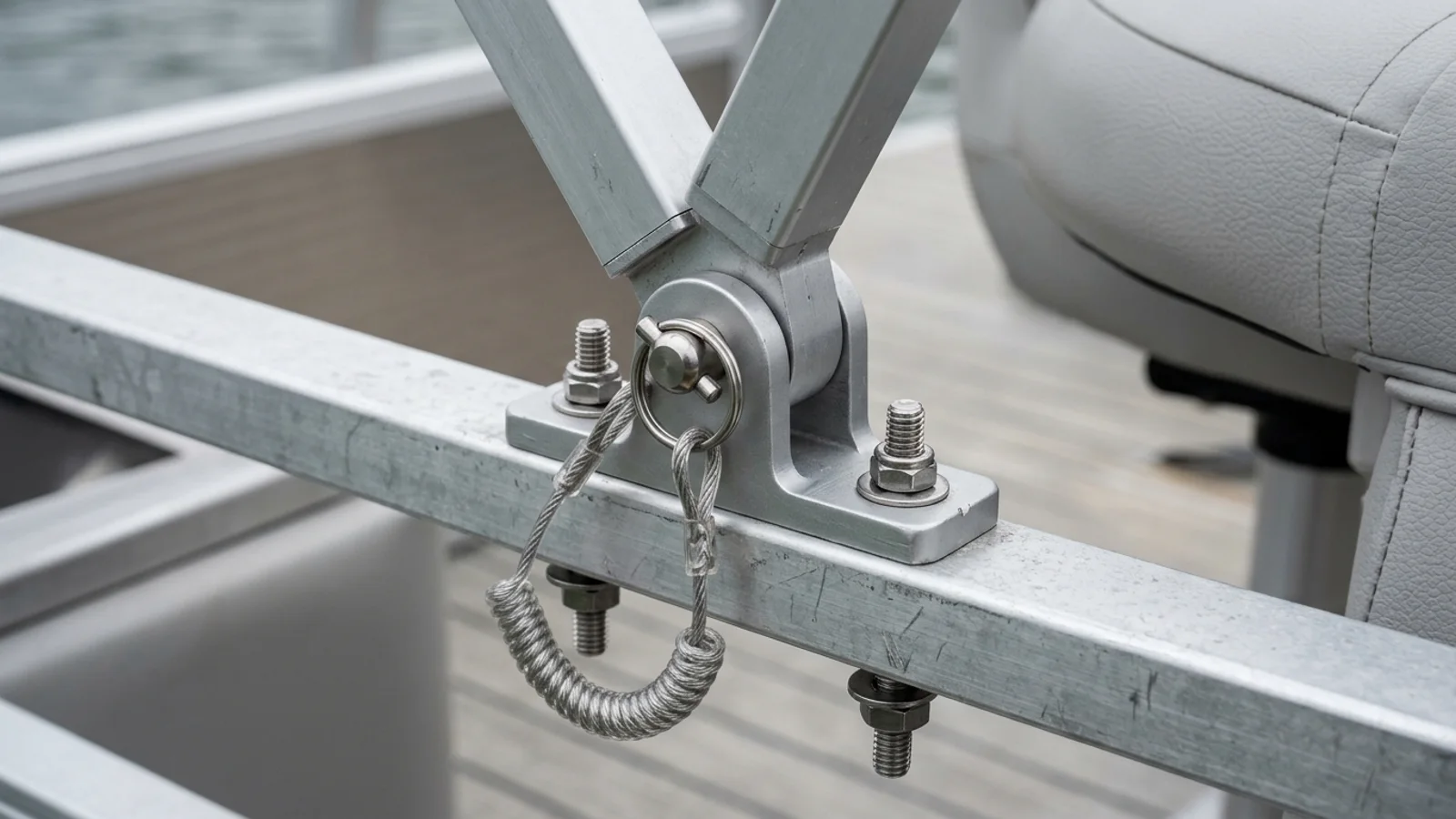
Measure the distance in height from the rail mounting points to the desired standing height under the deployed canopy.
Brace Hardware, Power Bimini Layout, and Folded Trailering Speeds
During frame layout, the main bow deck hinges must be positioned directly opposite each other on the port and starboard rails. Rear support braces attach to fixed 90° deck hinges angled between 45° and 60° and fasten to the rail with a 9/64” drill bit and No. 10 x 1” sheet metal screws. On an 8-foot Free-Standing top, the rear braces mount 47” aft of the main deck hinge while the front jaw slides clamp 2 1/2” down using a 4mm or 1/8” Allen wrench.
Replacement 1” square-tube brace hardware includes a 33” Brace Kit for 48”H pontoon bimini tops, a 38” Brace Kit for 54”H tops, and a 48” Brace Kit with fixed 90° deck hinges, #10 x 1” screws, and 3/16” rivets. For round-tube 35” Super Sport or 46” 3-Bow tops, frame height can be reduced by up to 10” by cutting equal lengths off the bottom of the long bow only and redrilling with a 3/16” drill bit. Round-tube 7/8” brace kits are available in fixed 48” or telescoping 22” to 44” lengths, and Slide Track Kits in 18”, 24”, 36”, 48”, and 60” lengths attach with #8 x 1” screws and a 1/8” drill bit so a folded top can slide into storage position. On heavier 1.25” 4-bow square-tube frames, the hardware kit provides 8 joiner pieces measuring 6” long, 2 quick-release pull pins, 6 high-rise mounts, 6 #10 x 24 x 1 3/4” bolts, and 6 #10 x 24 lock nuts.
When installing a Lippert or SureShade Power Bimini, the rear struts must sit just behind the rear seats so the folded bows clear the upholstery, mounting through two 3/8" holes drilled 1/2" and 16-1/2" back from the line traced across the front of each strut/actuator assembly with 5/16" x 1-3/4" bolts, 5/16" flat washers, and a 1/2" wrench. The rear strut H-bracket mounts at least 1/2" behind the middle strut H-bracket using a 3/8" nut-driver and a 1/4" self-tapping screw, while 1/4" x 1-1/2" Phillips screws secure the stand-off legs and the center bows insert into the actuators until the bimini width matches the boat rear frame width. Electrical actuator harnesses use 16 GAUGE wire protected by a 6 AMP breaker (121A06-A2M-HD) and a DPDT switch mounted in a 1/2" console hole, with #10 x 3/4" screws fastening the struts and bows, and the actuators must never be powered to Full Open without the canvas installed. Underway speed limits for the Power Bimini are 25 MPH in the Full Open position and 5 MPH in the Vari-pitch position. For folded travel, the Power Bimini is rated up to 50 MPH in the Radar Position with the protective boot installed, and up to 65 MPH in the Full Down Position with the boot installed versus 5 MPH without the boot.
If the Power Bimini will not close (retract), a 5/32" hex wrench removes two 1/4" hex cap screws so the frame can be folded manually and secured with the front canvas pockets and zip ties, hook-and-loop strips, or cordage before getting underway. Manual 1.25” square-tube pontoon biminis carry a maximum deployed operating speed of 35 MPH and must be stowed in the protective boot during highway trailering or higher-speed runs. Folding a manual square-tube top into back storage position requires releasing the front struts (remove the pull pins from the front high-rise mounts), folding the frame all the way back onto the rear bow, covering the canvas area with the storage boot, and zipping it closed. Carver canvas maintenance specifies rinsing with water no warmer than 100º F and spot cleaning stubborn stains with 1/4 cup mild soap and 1 cup household bleach per gallon of lukewarm water, followed by thorough rinsing and air-drying. Lippert power bimini fabric care mixes 1/4 cup mild dish soap in 5 gallons of warm water and requires the canopy to dry completely before being zipped into the storage boot.
| Bimini System & Mode | Frame Geometry | Published Speed Rating | Required Support / Boot State |
|---|---|---|---|
| Manual 1.25” square-tube | Deployed upright | maximum deployed operating speed of 35 MPH | Protective boot for trailering |
| Power Bimini Full Open | Canopy fully deployed | 25 MPH in the Full Open position | Canvas installed on bows |
| Power Bimini Vari-pitch | — | 5 MPH in the Vari-pitch position | — |
| Power Bimini Radar Position | — | 50 MPH in the Radar Position | Protective boot installed |
| Power Bimini Full Down | — | 65 MPH in the Full Down Position with the boot installed versus 5 MPH without the boot | Protective boot installed |
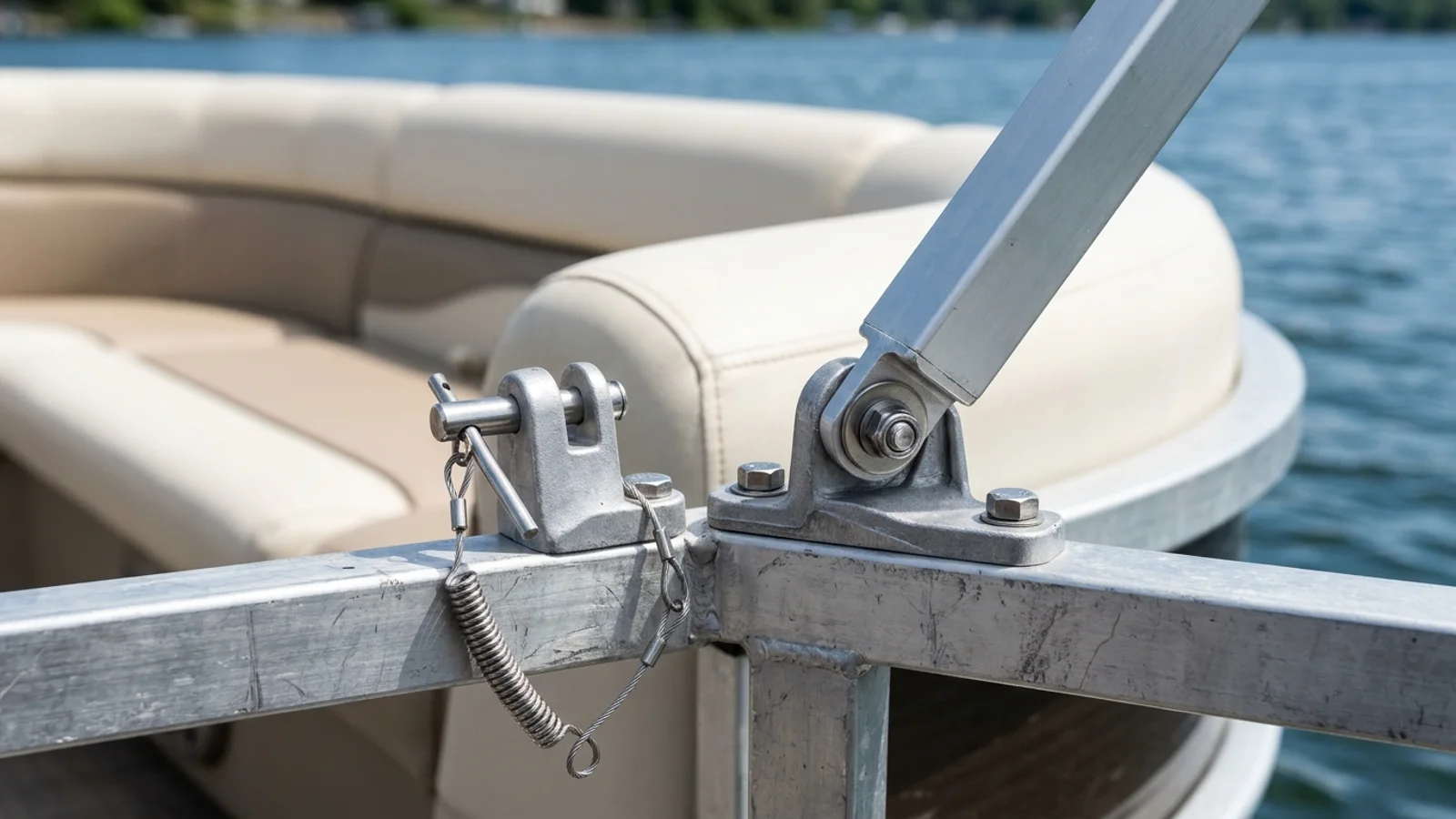
Always install the zippered storage boot before trailering and travel with the top stored inside the storage boot.
Fold Clearance for Bridges, Garage Doors, and Highway Trailering
As outlined in our boat garage fit and trailer measurement checklist, total trailered height must be measured from the ground to the highest fixed or stowed point—whether windshield, console grab rail, folded bimini, tower, rod holder, radar arch, or engine cowl—and any folded configuration requires a separate dimension drawing. No federal vehicle height requirement applies for commercial motor vehicles on U.S. highways, and most state vehicle height limits range from 13 feet, 6 inches (4.11 meters) to 14 feet (4.27 meters), so owners who trailer under low garage headers or tree canopies should request a pontoon configuration review to verify folded strut height before ordering. For highway beam context, the federal 102 inches (2.6 meters, or 102.36 inches metric equivalent, and 108-inch in Hawaii) width standard under 23 CFR 658.15 applies to commercial motor vehicles on the National Network rather than recreational boat trailers, which remain governed by state trailer rules.
- Under NOAA U.S. Coast Pilot Chapter 1 paragraph 17, published vertical bridge clearances are referenced to Mean High Water (MHW), except in Coast Pilot 6 where Great Lakes and connecting waterway clearances are referenced to Low Water Datum (LWD).
- Published drawbridge clearances apply to the closed span unless noted otherwise, and horizontal clearances are listed in Coast Pilot tables only when the channel opening is less than 50 feet (15 meters).
- Where NOAA ENC bridge clearances are referenced to a controlling USACE gage, remaining vertical clearance equals the charted clearance minus the current river stage (e.g. 166 ft − 4 ft = 162 ft).
- NOAA Electronic Navigational Charts (ENC) truncate decimal bridge heights down to the nearest whole integer—displaying a 166.6 feet clearance as 166 feet on the chart cell while recording the exact value of 166.6 feet in the diagram.
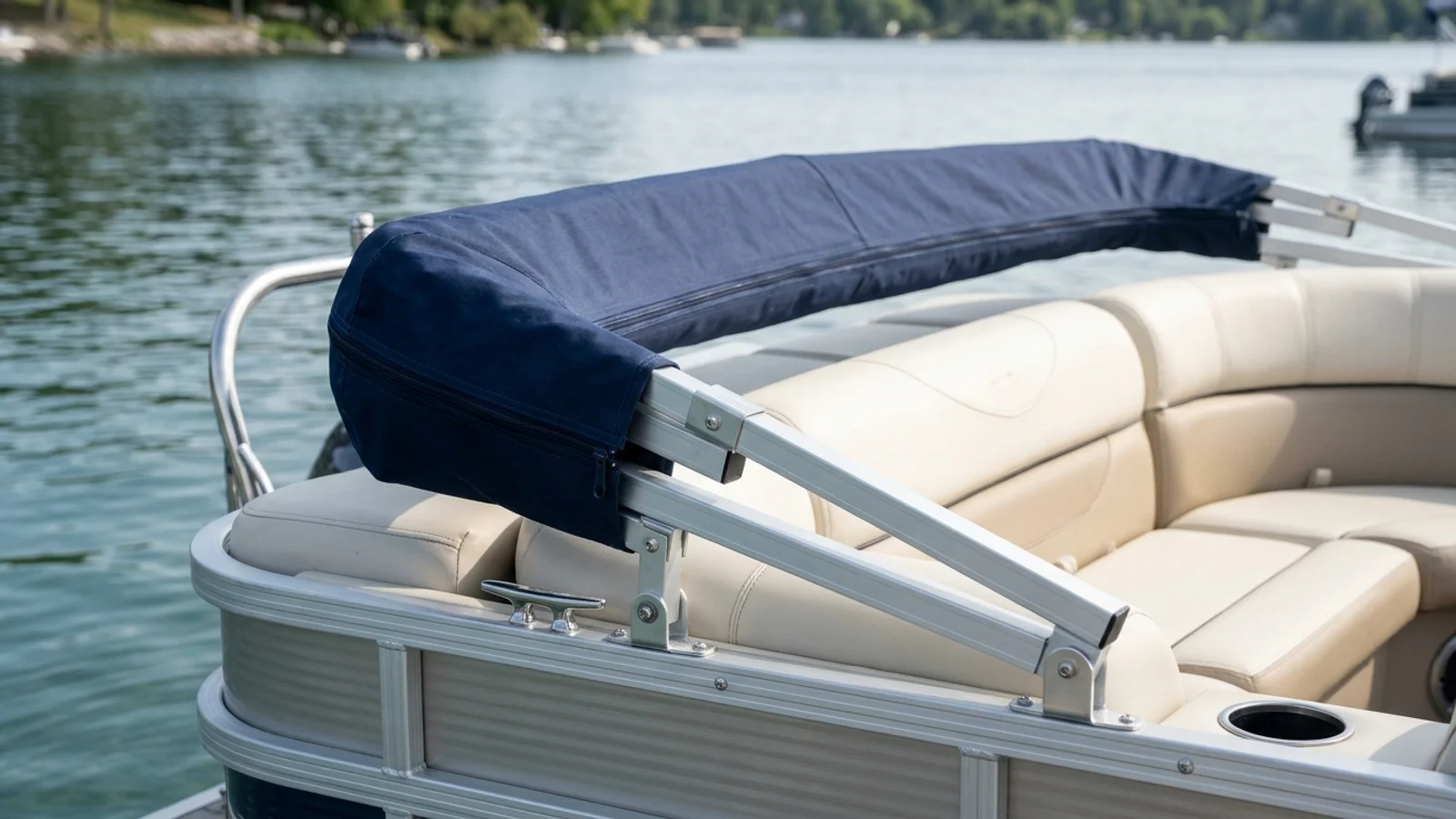
Verify folded strut height above the trailer ground plane before finalizing your bimini hardware.
Sources
Reference specifications, installation dimensions, operating speed limits, highway width and height rules, and bridge clearance standards in this guide are drawn from the following technical manuals and regulatory publications.
- Kinocean — Aluminum Pontoon Boat Entertainment Series Catalog Specifications
- SEAVIA Boats — Pontoon Floor Plan and Beam Guide and Boat Garage Fit Trailer Measurement Checklist
- Carver by Covercraft — How to Measure for a Bimini Top and Square Tube Pontoon Bimini Specifications
- Carver by Covercraft — Pontoon Bimini Top Installation Instructions, Brace Kit and Slide Track Manual, and Square Tube Operation and Care Guide
- Taylor Made — Pontoon Bimini Top Product Specifications
- Sunbrella — Marine Tops Fabric Performance and UV Protection Reference
- Lippert and SureShade — Power Bimini Owner and Installation Manual
- National Oceanic and Atmospheric Administration — United States Coast Pilot Bridge Clearance Rules and Coast Survey Inland River Bridge Clearances
- Federal Highway Administration — Federal Size Regulations for Commercial Motor Vehicles and State Height Limits